Packaging & Visual Research
See which packs, logos, and visual creative actually capture attention, drive preference, and stand out in competitive environments. Empirically measured, not assumed.
What we test
Shelf & in-context packaging tests
Your pack on a realistic shelf alongside its true competitors. Participants scan and shop as they would in store. We measure time-to-first-fixation, dwell time, fixation counts, and which neighbours steal attention from your pack. Paired with choice, reaction-time, and post-task survey data, the results provide the fulll customer journey: which packs are noticed, considered, chosen, and preferred.
Focused design comparison
We compare your design variants, or your design against competitor packs, shown side-by-side or sequentially on a neutral background that isolates the design from the rest. AOI-level attention metrics (logo, claim, hero image, CTA etc) are compared between variants and contrasted with brand recognition and stated preference, so the design verdict is grounded in attention, recognition, and liking together.

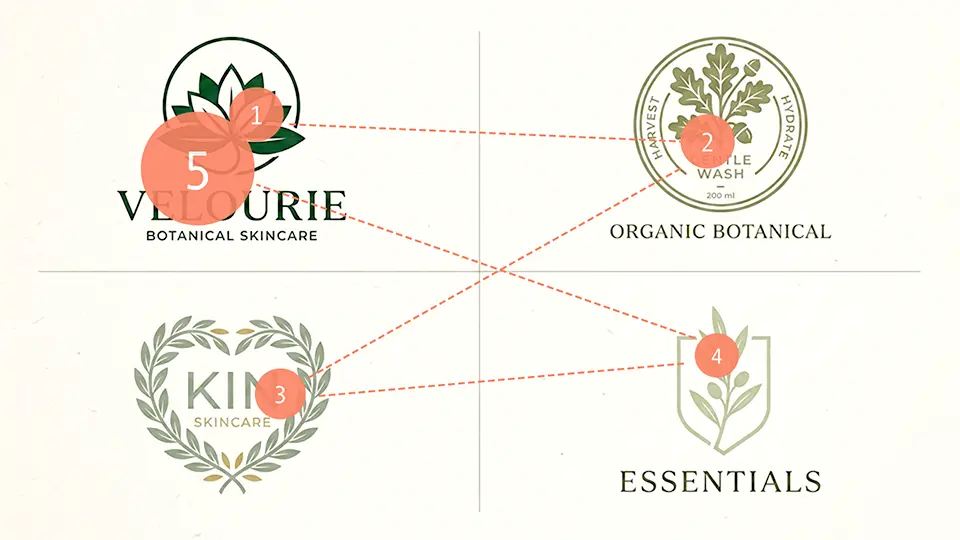
Logo & brand-mark testing
Logos, brand marks, and identity systems. We measure recognition speed, distinctiveness against category lookalikes, and the associations the mark evokes, using brief-exposure and similarity paradigms.
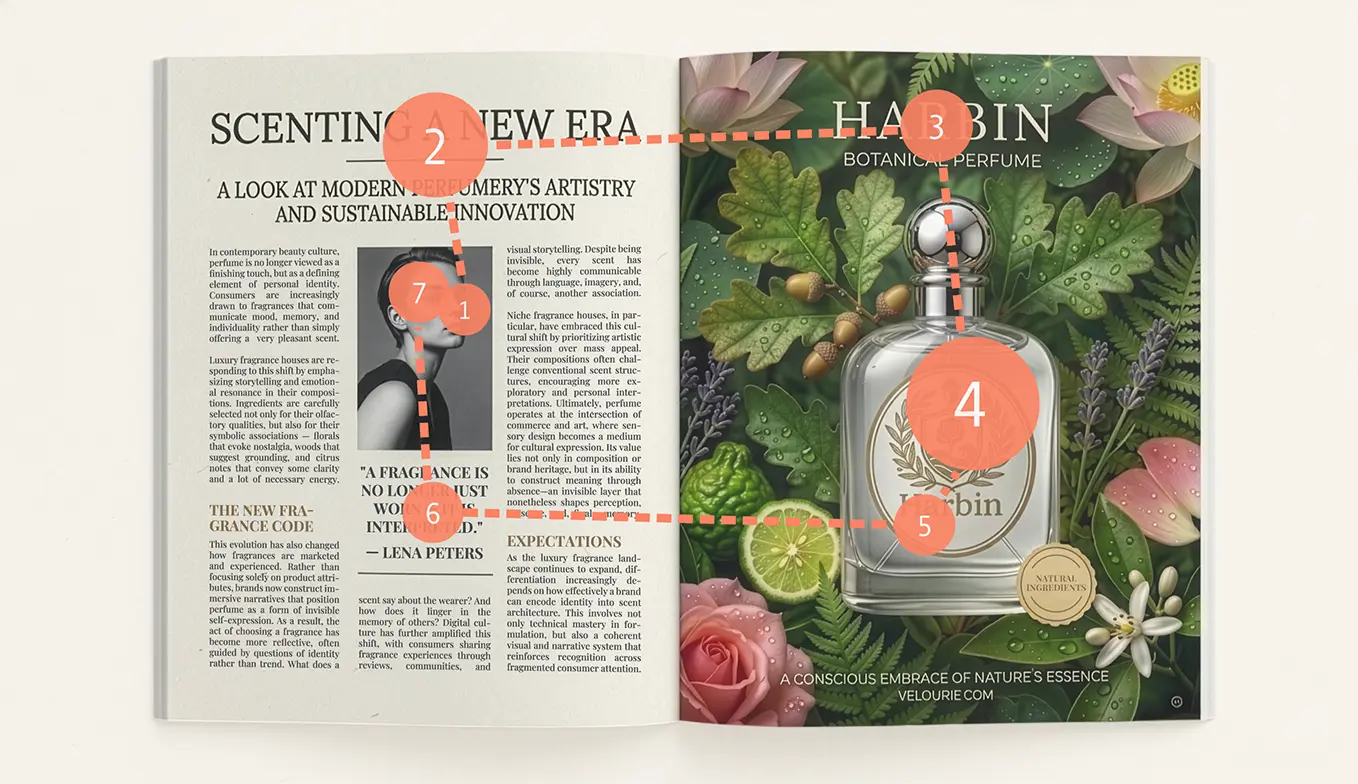
Print, OOH & magazine creative
Print ads, billboards, magazine spreads, and out-of-home creative — tested inside realistic surroundings, not in isolation. Your ad in a magazine spread among editorial; your billboard inside a street scene. We measure whether the hero message actually lands.
Typical questions we answer
These are representative examples, not a fixed set. If your question is not listed, it can most likely still be answered.
Anatomy of a typical study
Let's take a common packaging question: "Does our redesign actually win on the shelf, or only when looked at in isolation?" Here is how a shelf-attention study answers that.
Sample & setup
We build a realistic shelf rendering — your pack alongside its true competitors at correct facings, in the right category context. Then we recruit 120–180 shoppers from your target segment to view the shelf in their own browser. They are given a realistic shopping task, for example: "Imagine you are doing your weekly shop. Pick the product you would buy from this shelf and add it to your cart." Variants are counterbalanced so position effects do not contaminate the comparison.
What we measure
- Per pack: time-to-first-fixation, fixation count, and dwell time on the shelf
- Per AOI on your pack: dwell on logo, claim, hero image, and variant cue
- Brand-recognition latency — fixation on the logo vs. fixation on the overall pack
- Shopping choice, time to decide, and number of revisits to candidate packs
- Post-task unaided recall, confusion with adjacent SKUs, and stated preference and perceived premium
- Whether the per-variant differences hold across shopper segments (demographics, prior brand familiarity)
What you get
We deliver a written findings report, starting with an Executive Summary & Recommendations section, followed by our in-depth analysis. This includes per-pack and per-AOI attention metrics (time-to-first-fixation, dwell, recognition latency), choice and revisit behaviour, survey results (preference, perceived premium, recall, confusion), per-segment breakdowns, and statistical-significance tests. Attention heatmaps and scan-paths are added for the shelf as a whole and for each pack; AOI metrics are shown as bar charts in side-by-side comparative panels, and segment-cut versions. Both raw and processed data are appended to the report (gaze, fixations, choice, and survey responses). We present the findings to your team in a 60-minute live readout, and answer any follow-up questions for 2 weeks after.
Typical outcome
Our goal is to always provide you with the most actionable insights possible. For shelf-attention studies this often means it is one of three possible outcomes:
- Clear winner: One pack is both noticed faster and preferred when noticed, across the key shopper segments. The action is to ship it.
- Mixed picture: The redesign is preferred when looked at directly, but loses on the shelf — a smaller logo, muted variant cue, or lower contrast against neighbours costs visibility. The pack-element breakdown points to the specific design features to scale back up before launch.
- No clear difference: Both packs perform similarly on attention and choice. Key insight: the redesign is unlikely to be the lever here, and the team should look elsewhere (range architecture, shelf position, price perception).
Typical engagement
Single-pack and logo studies are usually lower complexity. Shelf and in-context studies are medium complexity because of the shelf rendering and AOI work. Multi-pack or multi-segment programmes scale up from there. Cost depends mainly on that complexity (stimulus build, AOI scope, analysis depth) and the sample size the question requires.
See the full engagement process on the homepage.