Behavioral & Custom Research
Implicit testing, decision research, and bespoke experiments for questions that go beyond attention. When the answer needs to reach what people cannot self-report, this is the category.
What we test
Pre-built behavioural paradigms
Validated experimental paradigms applied to your topic: implicit-association tests, pairwise-choice tasks, conjoint, attention paradigms, memory probes. Off-the-shelf scientific tools, adapted to your stimuli and audience, with the rigour of the academic methods they come from.
Custom interactive studies
Bespoke experiments built for novel questions. Multi-step decision flows, interactive simulations, custom paradigms designed against your hypothesis. If it can be done in a browser, we can build it — and design the analysis to match.
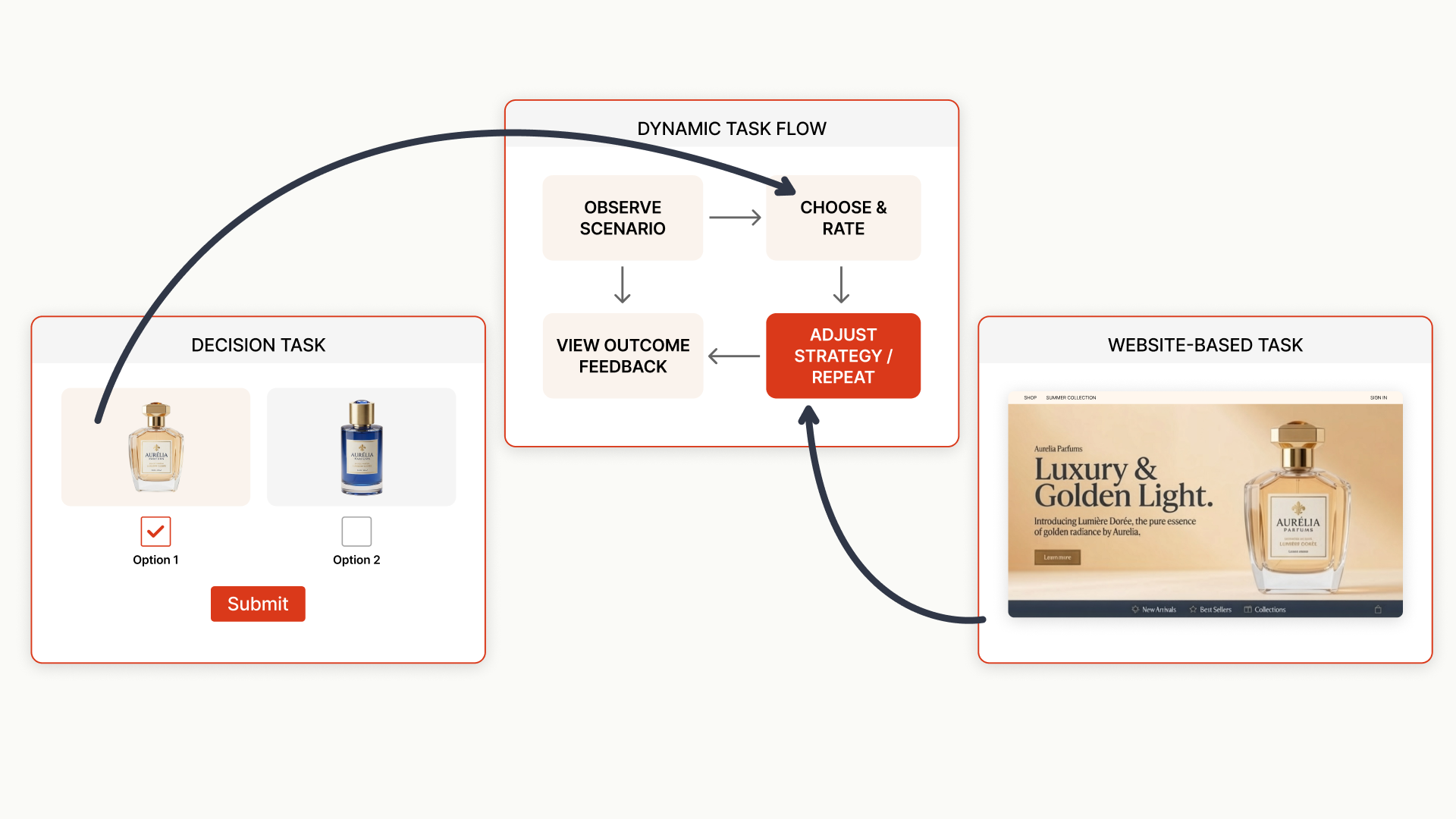
If your research question does not fit digital, packaging, or video, this is where it lives. Most behavioural studies layer in attention measurement and survey data, so you get the implicit, behavioural, and explicit channels in one read.
Typical questions we answer
These are representative examples, not a fixed set. If your question is not listed, it can most likely still be answered.
Anatomy of a typical study
Let's take a common behavioural question: "Will customers actually accept our new pricing structure, or only say they will in the survey?" Here is how a multi-method behavioural study answers that.
Sample & setup
We recruit 180–280 participants from your customer base or target segment to complete the study in their own browser. The session layers three channels back-to-back: (1) an implicit pairwise-choice task where they choose between products at different price points under time pressure (reaction time and choice), (2) a realistic mock-purchase task in a simulated checkout flow with your full price structure, and (3) a post-task survey with stated willingness-to-pay, perceived fairness, and reasons. Order is counterbalanced across participants so sequence effects do not contaminate any one channel.
What we measure
- Implicit choice patterns and reaction times across the tested price points
- Choice share, basket size, and drop-off in the mock checkout
- Stated willingness-to-pay, perceived fairness, and price-sensitivity from the survey
- Individual-level gap between stated and revealed preference — who matches and who diverges
- Where eye tracking is layered in: attention to price, comparison behaviour across tiers, and which tier elements are read versus skipped
- Cross-segment differences (existing customers vs. prospects, light vs. heavy users)
What you get
We deliver a written findings report, starting with an Executive Summary & Recommendations section, followed by our in-depth analysis. This includes per-channel results (implicit task, mock checkout, survey), the cross-channel gap analysis at population and segment level, behavioural choice metrics (share, reaction time, drop-off), survey results (willingness-to-pay, perceived fairness, reasons), per-segment breakdowns, and statistical-significance tests. Visualisations include reaction-time distributions, choice-share bar charts, willingness-to-pay distributions per tier, and stated-vs-revealed scatter plots. Both raw and processed data are appended to the report (trial-level choice and reaction time, mock-checkout events, survey responses). We present the findings to your team in a 60-minute live readout, and answer any follow-up questions for 2 weeks after.
Typical outcome
Our goal is to always provide you with the most actionable insights possible. For behavioural pricing studies this often means it is one of three possible outcomes:
- Pricing accepted: implicit reaction times do not slow at the new price, observed choice share holds in the mock checkout, and stated willingness-to-pay aligns. The three channels agree. Action: ship the new structure.
- Stated–revealed gap: customers say they will accept, but their implicit responses and observed choices say otherwise (slower decisions, drop in choice share, basket shrinkage). The behavioural signal is the better predictor here — stage the change, adjust the structure, or re-test a softer version before rollout.
- Segment split: pricing works for one segment and not another (e.g. existing customers accept, prospects bounce). The recommendation is segmented pricing or messaging tailored per cohort, with the cohort-level evidence to back the call.
Typical engagement
Pre-built paradigm applications (IAT, pairwise choice, conjoint) on standard stimuli are at the faster, more contained end. Custom multi-method studies sit higher because the design is bespoke and the analysis crosses implicit, behavioural, and self-report channels. Cost depends mainly on that complexity (paradigm design, number of conditions, depth of cross-channel analysis) and the sample size the question requires.
See the full engagement process on the homepage.