Digital Experience Research
See where attention goes and how users interact with your live website, functional prototype, or design mockups. By combining attention, behavior, and biometric data, we help you to improve your customer experience.
What we test
Live website testing
We load your real site in participants' browsers via our Chrome extension. They browse naturally while we measure where they look, what they engage with, and where they get stuck. No changes to your site needed.
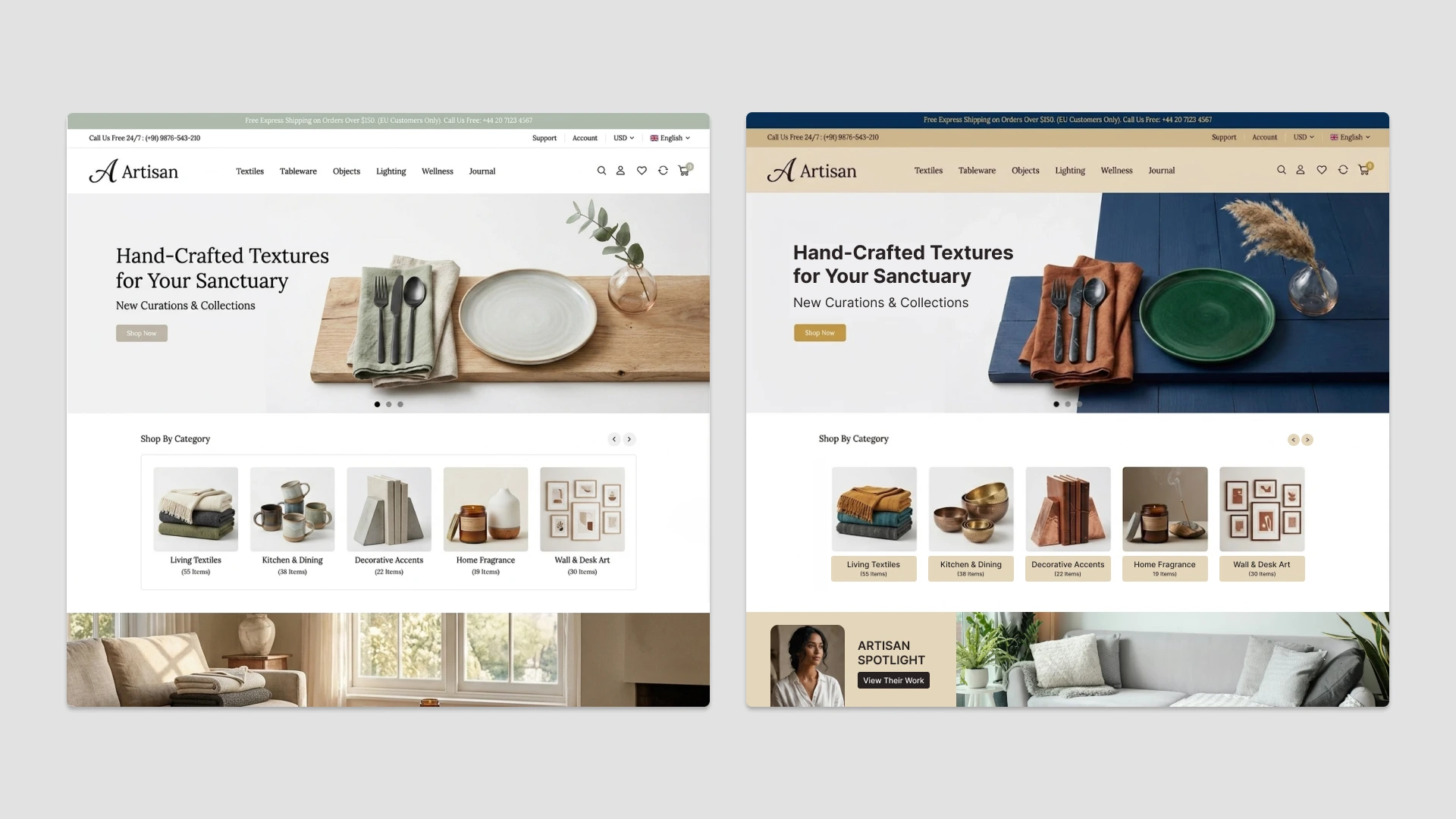
Prototype & design comparison
We take your designs and turn them into functional prototype that users can interact with. Often two or more versions are tested in parallel. We compare attention patterns, engagement, and behavior across these variants so you can make informed decisions about your design.
Typical questions we answer
These are representative examples, not a fixed set. If your question is not listed, it can most likely still be answered.
Anatomy of a typical study
Let's take a common digital experience question: "Which of two design variants for our webshop delivers the better experience?" Here is how a variant comparison study answers that.
Sample & setup
We take your designs (e.g Figma files) and turn them into functional prototypes that run directly on our measurement platform. Then we recruit 150 participants from the target audience to browse the variants in their own browser. Variants are counterbalanced across subjects. They are given a realistic task, for example: "Add a full meal and an appetizer to your cart and proceed to checkout. Also add two extras."
What we measure
- Per variant: time-to-first-fixation and dwell time on key elements (e.g. product cards, prices, search, cart, checkout)
- Per variant: navigation paths, scroll depth, and dwell on the basket and checkout steps
- Task completion rate, time on task, and number of misclicks or dead-ends
- Stated preference, perceived ease, and trust after the task (post-task survey)
- Whether the per-variant differences hold across customer segments (demographics, prior shopping habits)
What you get
We deliver a written findings report, starting with an Executive Summary & Recommendations section, followed by our in-depth analysis. This includes per-variant and AOI attention metrics (e.g. dwell-time, time-to-first-fixation), behavioural metrics (completion rate, time on task, misclicks, navigation paths), survey results (e.g. preference, ease), per-segment breakdowns, and statistical-significance tests. Attention heatmaps and scan-paths visualizations are added for each screen and AOI metrics are shown as bar charts in side-by-side comparative panels, and segment-cut versions. Both raw and processed data will be appended to the report (gaze, fixations, clicks, navigation paths, and survey responses). We will present the findings to your team in a 60-minute live presentation, and answer any follow-up questions for 2 weeks after.
Typical outcome
Our goal is to always provide you with the most actionable insights possible. For design comparisons this often means it is one of three possible outcomes:
- Clear winner: One variant outperforms the other across attention, behaviour, and stated ease / preference. The action is to ship it.
- Mixed picture: Each variant wins on different elements, metrics or segments (e.g. variant A captures more attention on key elements and has a higher stated preference; but variant B has a faster checkout). The actionable answer is often to create a new version combining the stronger parts.
- No clear difference: The variants perform similarly across the board. Key insight: The design choice likely is not the main driver, and the team should look elsewhere in the flow (pricing, product offering, audience fit).
Typical engagement
Live website testing is usually a medium-complexity study. Prototype and design comparison is more involved, since we build the interactive versions first, which adds time. Cost depends mainly on that complexity (design and analysis depth) and the sample size the question requires.
See the full engagement process on the homepage.