How webcam eye tracking works — and how we validated it
Eye tracking has traditionally required expensive hardware — dedicated infrared cameras, chin rests, and controlled lab environments. Webcam-based eye tracking changes that equation entirely. The interesting question is no longer whether it works, but how close it gets to the laboratory standard, and what kinds of research questions it can now reliably answer.
How it works
Modern webcam eye tracking uses the front-facing camera on a participant's laptop or desktop to estimate where they are looking on the screen. The pipeline has four steps:
- Face detection — locate the face and eyes in the camera feed.
- Feature extraction — identify key landmarks (pupil position, eye corners, head pose).
- Gaze estimation — map eye features to screen coordinates using a calibrated model.
- Calibration — each participant completes a brief calibration sequence to account for their individual setup, camera position, and viewing distance.
There is no hardware to ship, no software to install. The participant opens a link in their normal browser; the calibration takes about a minute; the study begins.
Validated against EyeLink 1000 in Behavior Research Methods
The harder claim — that this is good enough to draw conclusions from — is supported by a 2023 peer-reviewed validation study. Kaduk, Goeke, Finger, and König published in Behavior Research Methods a head-to-head comparison of the Labvanced webcam eye-tracking system (the same system that powers Pagegazer studies) against the EyeLink 1000, the most widely-used research-grade infrared eye tracker. The two systems recorded simultaneously while participants completed five different tasks — a Large Grid calibration sweep, smooth-pursuit eye movements, viewing of natural images, and two head-movement conditions.
The headline numbers from that paper:
- Accuracy: 1.4° (overall), 1.3° at central targets. The EyeLink achieved 0.91° on the same tasks. The webcam error is roughly 0.5° larger than the laboratory system — and represents about a 300% improvement over earlier webcam solutions.
- Precision: 1.1°. Approximately 0.5° looser than EyeLink.
- Correlation between systems on raw gaze samples: 90% on the Large Grid task, 80% on Free View and Smooth Pursuit. In other words, on a moment-by-moment basis, the two systems agree about the direction of gaze a large majority of the time.
The authors conclude that webcam eye tracking now performs roughly on par with mobile eye-tracking devices — not as good as a desktop EyeLink, but in the same regime, and good enough for the questions most non-laboratory research is trying to answer.
What 1.4° means in practice
At a typical viewing distance of 60 cm from a 24-inch monitor, 1.4° of visual angle corresponds to roughly 1.5 cm on the screen.
That is precise enough to:
- distinguish between adjacent paragraphs of text;
- identify which product in a row is being fixated;
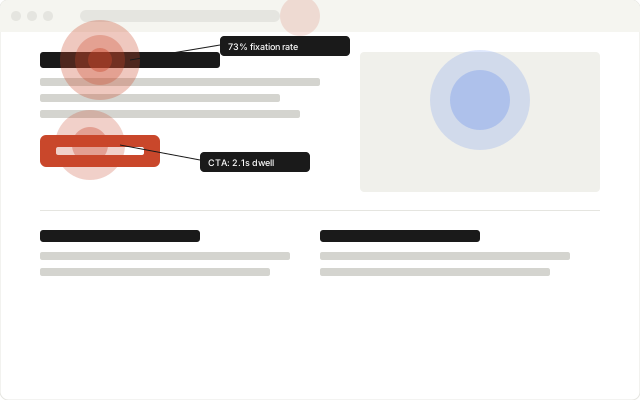
- determine whether a specific button, headline, or call-to-action is being noticed;
- measure dwell time on a packaging element, a video frame region, or a UI control.
It is not precise enough to distinguish individual letters within a word, or to do certain kinds of micro-saccade research that an infrared system supports. But it covers the great majority of commercial research questions, and the recent peer-reviewed literature confirms this. Serrano-Carot, Angele, Xu, and Vasilev (2025) showed that webcam eye tracking can reproduce the established laboratory effects of word frequency and skipping cost during reading — the most demanding visual task on a screen.
When it works less well — and what we do about it
Webcam eye tracking is more sensitive to environment than the laboratory equivalent. It works less well in low-light conditions, with significant head movement, or with certain eyeglass configurations. We address this in three ways:
- Calibration validation. Every session ends the calibration sequence with a verification step. If gaze error exceeds threshold, the participant re-calibrates or is excluded.
- Environmental checks. Lighting and webcam quality are screened before data collection begins.
- Quality-driven exclusion. Sessions where data quality is insufficient are excluded from analysis. Typical exclusion rates are 5–10%, which is comparable to attrition in traditional online research.
Patterson, Nicklin, and Vitta (2025) consolidated these and other recommendations into a methodological scoping review in Research Methods in Applied Linguistics — now a reference for running webcam eye-tracking studies at scale.
Why this matters for commercial research
The practical implication is large. Instead of bringing 20 participants to a lab, you can test 200 participants in their own environments — on the actual stimuli they will encounter in the real world. Sample sizes are bigger, turnaround is faster, the setting is closer to ecologically valid, and the methodology has now been published and replicated independently across reading research, attention research, packaging research, and clinical decision-making research.
The hardware-eye-tracker era did not end. It became one tool among several. For the questions Pagegazer answers — where does attention go, what is noticed and what is missed, where does engagement drop — the browser is now the right instrument.
A figure from Kaduk et al. (2023) — for example, the comparison of accuracy across the screen between the webcam system and EyeLink — would fit well here. The paper is published under CC-BY 4.0 and figures can be reused with proper attribution.
Citations
- Kaduk, T., Goeke, C., Finger, H., & König, P. (2023). Webcam eye tracking close to laboratory standards: Comparing a new webcam-based system and the EyeLink 1000. Behavior Research Methods, 56(5), 5002–5022. doi.org/10.3758/s13428-023-02237-8 (CC-BY 4.0)
- Serrano-Carot, M., Angele, B., Xu, H., & Vasilev, M. R. (2025). Webcams Can Be Used to Study Eye Movements during Reading. PsyArXiv. doi.org/10.31234/osf.io/bzt2h_v1
- Patterson, A. S., Nicklin, C., & Vitta, J. P. (2025). Methodological recommendations for webcam-based eye tracking: A scoping review. Research Methods in Applied Linguistics. doi.org/10.1016/j.rmal.2025.100244
For an overview of webcam eye tracking and how Pagegazer applies it as a service, see webcam eye tracking for consumer research. For a fuller list of peer-reviewed work using the same measurement platform, see published research.
Have a research question?
Submit a project enquiry →